
In today’s digital world, users expect websites to load almost instantly. Whether on a desktop, tablet, or mobile device, users rarely tolerate slow response pages. Research consistently shows that even a one-second delay can significantly reduce end-user satisfaction, harm search engine rankings, and reduce revenue.
Website speed is no longer only a technical issue for web developers; it is now vital to SEO, user experience, and conversion rate optimisation. Companies that focus on improving their website performance gain a competitive advantage through better search engine rankings, lower bounce rates, and higher customer engagement.
Search engines strive to provide the best experience for users, making website speed a key ranking factor.
Google has officially confirmed that page speed affects search rankings. With the advent of mobile-first indexing and the Google Core Web Vitals initiative, website performance now significantly affects page positioning in search results.
Although content quality and relevance are the top-ranking factors, a slow website can hinder your ability to compete with faster competitors offering similar content.
A website that loads quickly helps search engines:
As a result, fast websites often gain an advantage in search visibility.
Core Web Vitals are a set of metrics Google uses to measure real-world user experience. The three primary metrics include:
Largest Contentful Paint (LCP)
Measures how quickly the main content of a page loads.
Ideal target: Under 2.5 seconds
Interaction to Next Paint (INP)
Measures how responsive a page feels when users interact with it.
Ideal target: Under 200 milliseconds
Cumulative Layout Shift (CLS)
Measures visual stability and how much page elements unexpectedly move during loading.
Ideal target: Less than 0.1
Websites that perform well across these metrics provide a smoother experience, which can positively influence rankings and user engagement.
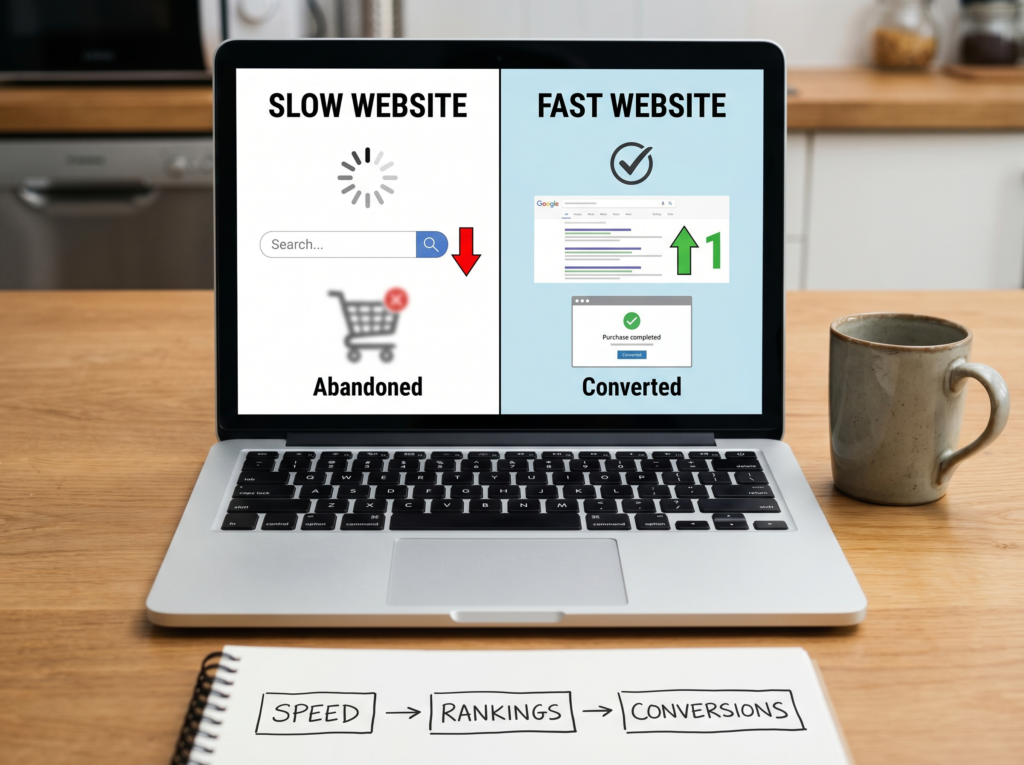
A slow website can negatively affect SEO in several ways.
Higher Bounce Rates
When users click a search result and encounter a slow-loading page, they’re more likely to leave before engaging with the content.
This sends negative engagement signals to search engines and can reduce the likelihood of achieving or maintaining strong rankings.
Reduced Crawl Efficiency
Search engine bots have a limited crawl budget. If pages load slowly, search engines may crawl fewer pages during each visit.
For larger websites, this can result in:
Poor Mobile Experience
Mobile users often browse using variable network connections. Slow-loading mobile pages create frustration and increase abandonment.
Given Google’s mobile-first indexing approach, poor mobile performance can directly impact rankings.
Website speed is fundamentally a user experience issue.
Visitors form opinions about a website within seconds. A slow website can immediately create perceptions that a business is:
Fast websites create a sense of trust and professionalism.
When pages load quickly, users are more likely to:
The smoother the experience, the more likely visitors are to become customers.

One of the most significant impacts of website speed is its effect on conversions.
Whether your goal is to generate leads, sell products, or encourage enquiries, page speed directly influences performance.
Faster Websites Generate More Leads
Visitors are more likely to complete forms, request quotes, or contact your business when pages respond quickly.
Slow-loading forms, landing pages, and calls to action often result in abandoned enquiries.
Improved E-commerce Performance
For online retailers, speed is directly tied to revenue.
Slow websites often experience:
Even small speed improvements can produce measurable increases in sales.
Better User Engagement
Fast websites encourage users to explore further.
This can lead to:
These engagement metrics often contribute to stronger overall marketing performance.
Many business owners underestimate the financial impact of poor website performance.
Consider this scenario:
If your website gets 10,000 visitors monthly and has a 3% conversion rate, even a slight decrease in conversion due to slow loading could lead to dozens of lost leads or sales each month.
Over the course of a year, the lost revenue can be substantial.
The hidden costs include:
Website speed should therefore be viewed as an investment rather than an expense.
Several factors can contribute to poor website speed.
Unoptimised Images
Large image files are among the most common causes of slow-loading websites.
Modern image formats and compression techniques can dramatically reduce file sizes without sacrificing quality.
Excessive Plugins
Many websites accumulate unnecessary plugins and scripts over time.
Each additional plugin can increase loading times and create performance bottlenecks.
Poor Hosting
Cheap or overcrowded hosting environments often struggle to deliver fast performance.
Quality hosting infrastructure is one of the most important investments for website speed.
Unnecessary Code
Bloated CSS, JavaScript, and outdated code can slow page rendering and reduce responsiveness.
Regular optimisation helps maintain efficient performance.
Lack of Caching
Caching allows browsers and servers to store frequently accessed content, reducing load times for returning visitors.
Without caching, websites must repeatedly generate content from scratch.

Improving performance doesn’t always require a complete website rebuild.
Some of the most effective optimisation techniques include:
Optimise Images
Enable Caching
Use a Content Delivery Network (CDN)
CDNs distribute website assets across global servers, reducing latency and improving loading speeds for visitors worldwide.
Minify CSS and JavaScript
Removing unnecessary code reduces file sizes and improves rendering performance.
Upgrade Hosting
A reliable hosting provider can dramatically improve website speed, uptime, and security.
Monitor Core Web Vitals
Regularly reviewing performance metrics helps identify issues before they impact rankings or conversions.
Many businesses prioritise SEO, advertising, and content marketing, but often overlook website performance.
However, speed often acts as a multiplier for all other digital marketing efforts.
A faster website can:
In competitive industries where companies compete for visibility and conversions, website speed often determines success or missed opportunities.
Website speed is not optional anymore. It is an essential element of SEO, user experience, and business growth.
A fast website helps search engines crawl and rank your content more efficiently while providing visitors with the effortless experience they expect. More importantly, it helps convert those visitors into customers.
Businesses that invest in website performance frequently see improvements across key metrics, from rankings and traffic to user engagement and revenue.
If your website feels unresponsive, now is the time to act. Even small improvements in loading speed can deliver considerable returns and provide a measurable competitive advantage in today’s online marketplace.
Contact our team of Digital Marketing Strategy specialists, who have the knowledge and expertise to fully optimise your social media and website, helping you increase the number of leads and conversions your business generates.
Call our team on 0121 439 5450, alternatively, fill out our contact form.